-
Understand Mega Backdoor Roth Conversion
- Latest in Retirement Savings & Personal Finance
- Understand Mega Backdoor Roth Conversion
- Tools & Tips: Backdoor Roth IRA Pro-Rata Conversion Calculator
- Market Overview
-
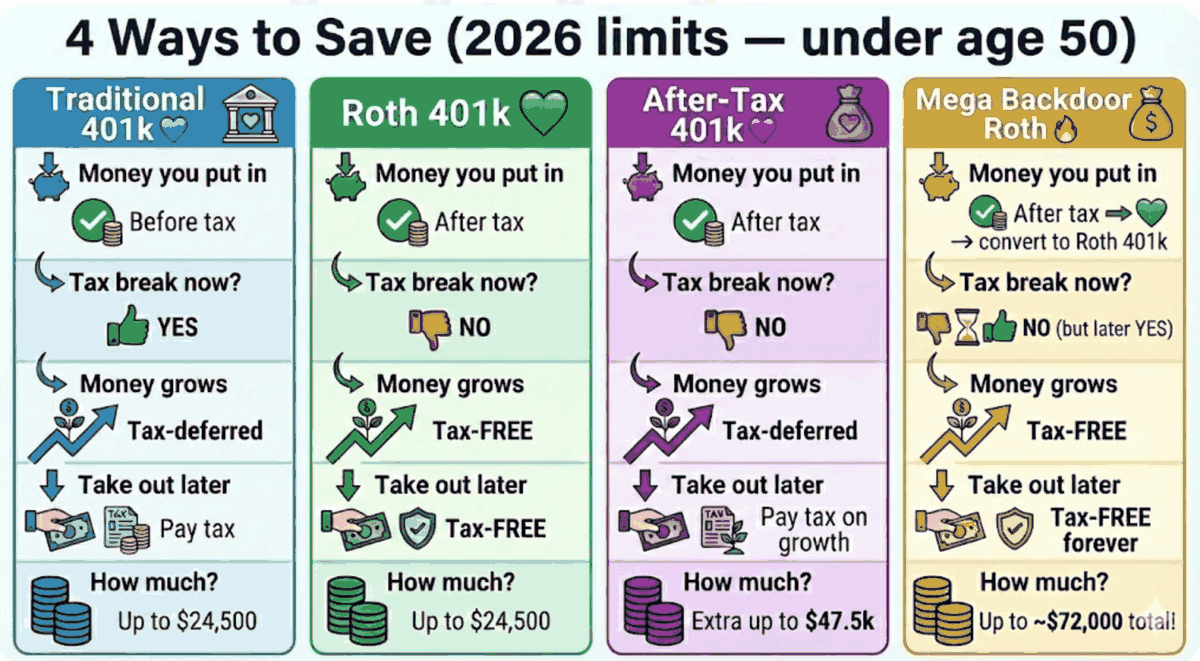
Mega Backdoor Roth Infographic
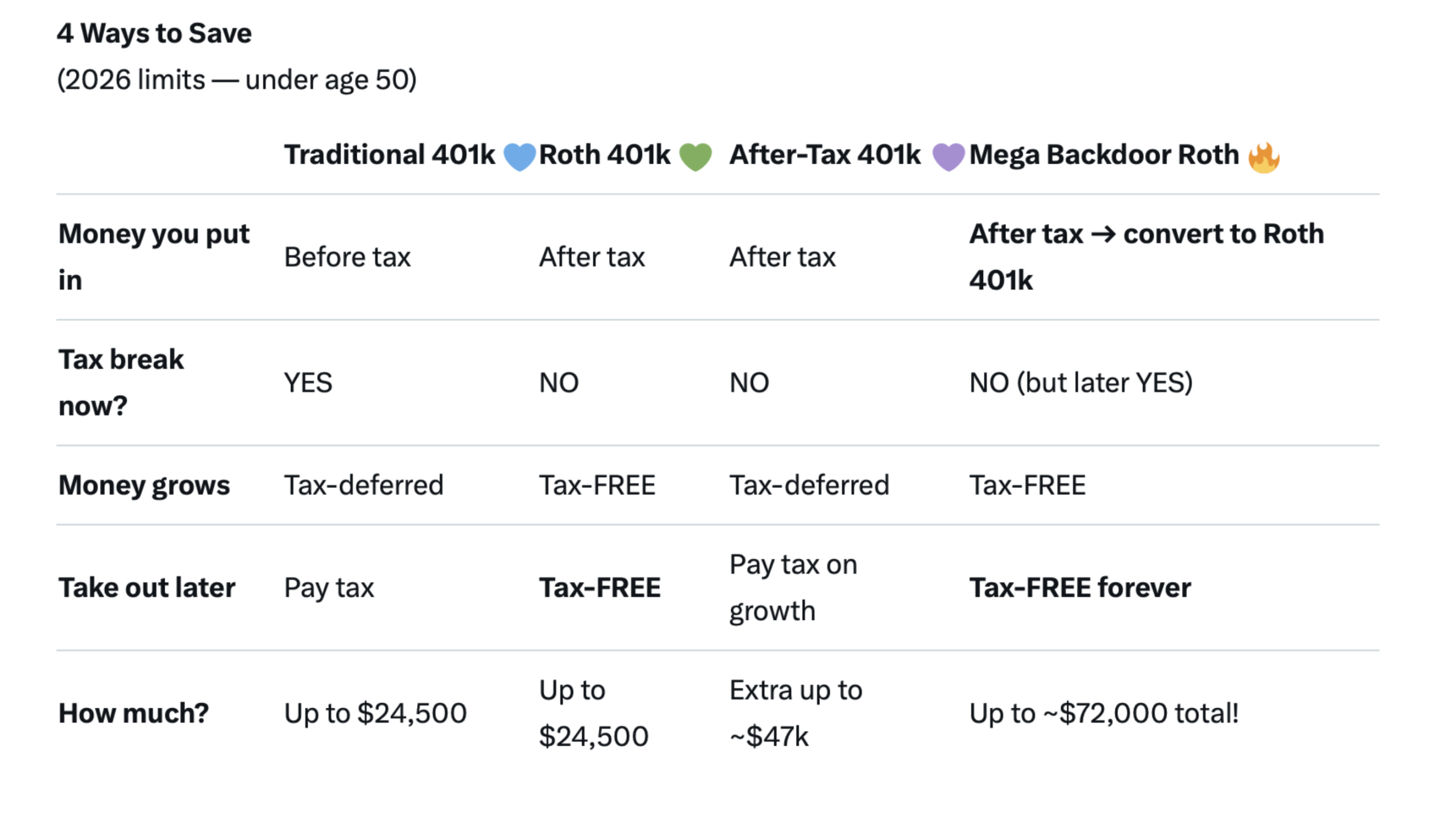
The infographic to illustrate the differences among traditional 401k, Roth 401k, After Tax 401k and Mega Backdoor Roth Conversion.
-

Retirement Plan Contribution Limits in 2026
Comprehensive retirement plans (401(k), 403(b, 457(b), Solo 401(k), SEP IRA, SIMPLE IRA, IRA, Roth IRA, TSP, HSA etc.) contribution limits for 2026
-

Best Strategy to Withdraw Funds in Retirement
When you retire, the order you pull funds from your accounts (whether taxable, traditional, or Roth) can make big difference.
-

Retirement Plan Contribution Limits in 2024
2024 Retirement Plan Contribution Limits 1. 401(k), 403(b), and 457(b) Plans Employee Contributions: Up to $23,000 (under age 50) Catch-up contribution: $7,500 (ages 50+) Total Combined Limit (Employee + Employer): $69,000 Roth Options: Available for 401(k), sometimes for 403(b) and 457(b) Plan Details: 401(k): Primarily for for-profit companies; includes Roth (after-tax) options. 403(b): For public schools and nonprofits; Roth-style options less common. 457(b): For state/local government and some tax-exempt organizations; Roth availability varies. 2. Solo 401(k) and SEP IRA Solo 401(k): For self-employed individuals/business owners without employees.
- Employee contributions: $23,000, plus $7,500 catch-up (ages 50+)
- Employer contributions: up to 25% of compensation
- Total combined limit: $69,000 or 25% of compensation, whichever is less
SEP IRA: Employer contributes up to 25% of compensation, up to $69,000. No catch-up contribution. 3. SIMPLE IRA
- Employee contribution: up to $16,500
- Catch-up contribution: $3,500 (50+)
- Employer must match dollar-for-dollar up to 3% of employee salary
- Immediate vesting
4. Traditional and Roth IRAs
- Annual contribution: $7,000
- Catch-up: additional $1,000 (50+)
Traditional IRA: Pre-tax contributions, taxable upon withdrawal Roth IRA: After-tax contributions, tax-free withdrawals 5. Thrift Savings Plan (TSP)
- Federal and uniformed services employees only
- Employee contributions: up to $23,000 (under age 50), plus catch-ups ($7,500 at 50+)
- Employer matches up to 5% of salary
- Total Combined Limit (Employee + Employer): $69,000
- Pre-tax (traditional) and Roth contributions allowed
6. Payroll Deduction IRA
- Annual limit: $7,000; catch-up of $1,000 (age 50+)
- Pre-tax or Roth contributions
- No employer matching
7. Health Savings Account (HSA)
- Individual coverage: $4,150
- Family coverage: $8,300
- Catch-up contribution: additional $1,000 for age 55+
- Must have a high-deductible health plan
- Tax-free growth; penalty-free medical withdrawals; penalty-free non-medical withdrawals after age 65 (taxable)
8. Self-Directed IRA (SDIRA)
- Contribution limits same as IRAs ($7,000 + $1,000 catch-up age 50+)
- Allows alternative investments (real estate, precious metals, crypto)
- Requires IRS-approved custodian
9. Nondeductible IRA
- Same limits as traditional IRAs ($7,000 + $1,000 catch-up age 50+)
- Contributions not tax-deductible; earnings taxable at withdrawal
10. Annuities and Pension Plans (Brief Overview)
- Annuities: Insurance-based retirement products, providing guaranteed income. High fees, limited liquidity.
- Pension Plans: Employer-funded defined-benefit plans providing guaranteed lifetime income. Limited investment control.
11. Flexible Spending Account (FSA) Limits for 2024
- The maximum employee contribution to a health care FSA for 2024 is $3,200.
- If the FSA plan allows for carryover, the maximum amount that can be carried over to 2025 is $640.
- For Dependent Care FSAs, the maximum remains $5,000 per household (single or married filing jointly) or $2,500 if married and filing separately.
12. Health Savings Account (HSA) Limits for 2024 Coverage Type 2024 Contribution Limit Catch-Up (Age 55+) Minimum Deductible Out-of-Pocket Max Self-only $4,150 +$1,000 $1,600 $8,050 Family $8,300 +$1,000 (per eligible spouse, each in own HSA) $3,200 $16,100
- Individuals age 55 or older can contribute an additional $1,000 as a catch-up contribution.
- HSA contributions can be made until the tax filing deadline (April 15, 2025, for tax year 2024).
- To be eligible for HSA contributions, you must be enrolled in a high-deductible health plan (HDHP) meeting the minimum deductible and out-of-pocket maximum requirements above.
-

Roth IRAs for Retirees
Roth IRAs can be very useful for retirees in terms of medicare premiums, estate planning and other benefits.
-
Retirement Plan Contribution Limits in 2025
Comprehensive retirement plans (401(k), 403(b, 457(b), Solo 401(k), SEP IRA, SIMPLE IRA, IRA, Roth IRA, TSP, HSA etc.) contribution limits for 2025
-

Solo 401(k) vs. SEP IRA: Which is Better for the Self-Employed?
This article compares Solo 401(k) and SEP IRA retirement plans. It discusses the pros and cons of both plans.
-
Solo 401(k) Annual Contribution Limits: Employee and Employer Contributions
This article discusses Solo 401(k) Annual Contribution Limits for both Employee and Employer Contributions. It further presents a simple strategy to decide the maximum contribution for Solo 401(k) and Solo Roth 401(k).
